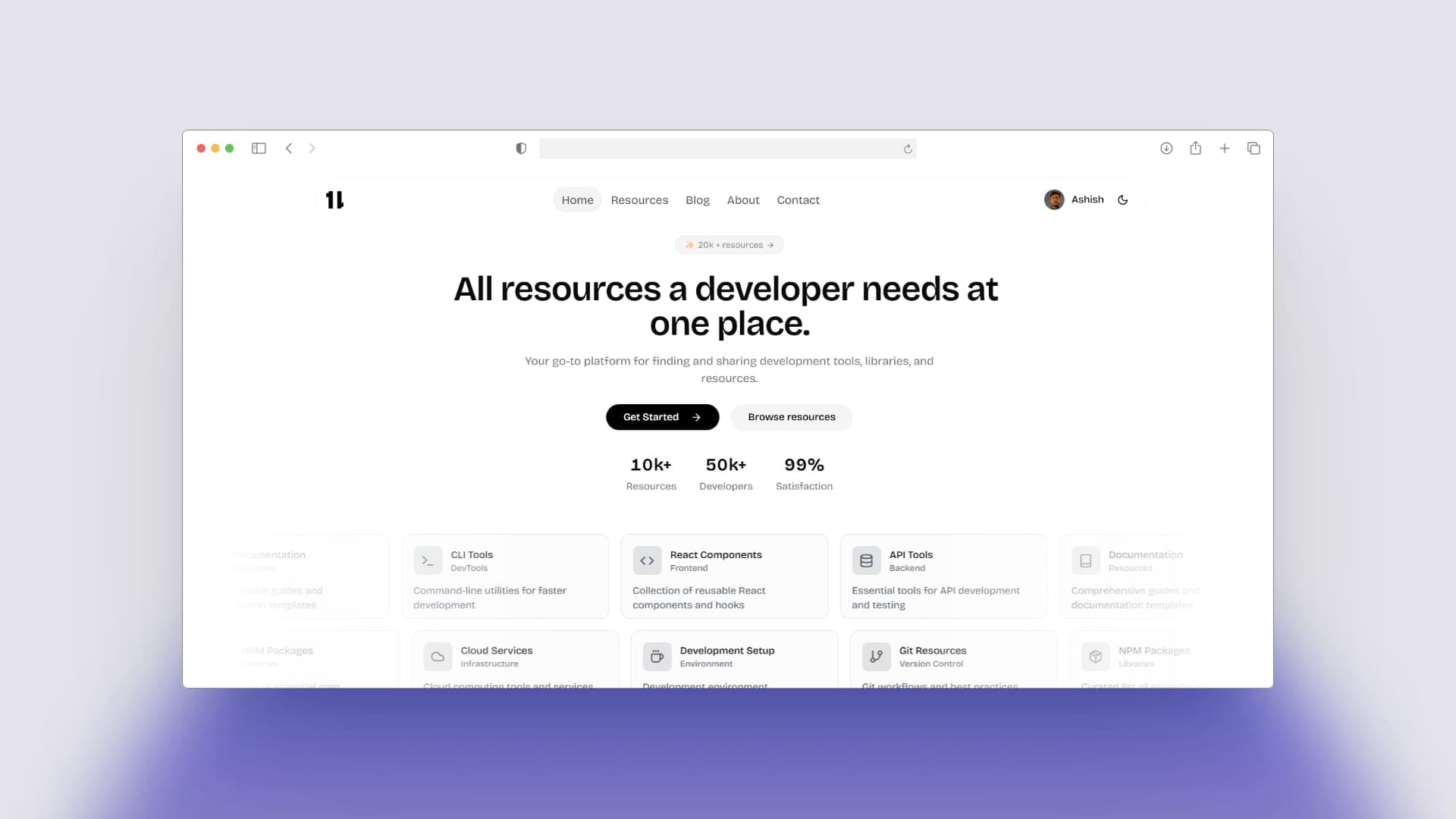
Most developer hubs feel like static bookmarks—buried, disorganized, and soon forgotten. But developers don't just need "more links"; they need a living system that adapts to their growth. I built ByteInit to solve this, creating a high-performance ecosystem where curated resources meet AI-driven personalization.
It’s not just a directory; it’s a career toolkit for the modern engineer.
The "Real" Challenge
Building a list is easy. Building a platform that manages 20,000+ resources while remaining lightweight and deeply personalized is where the complexity lies. I needed a system that could handle high-concurrency data fetching (Prisma + MongoDB) without sacrificing the "instant" feel that developers expect.
My mission: Zero-latency navigation, intelligent search, and an automated portfolio system that feels like it was written by a professional recruiter.
My Approach: Intelligence x Performance
1. Scaling with Next.js 15 & Turbopack
Every millisecond in a dev's workflow counts. I chose Next.js 15 to leverage Server Components and the Turbopack bundler. This ensures that even with a massive resource catalog, the initial paint is near-instant, providing a "local app" feel in a web environment.
2. The AI Narrator: Groq-Powered Portfolios
Instead of a generic bio, ByteInit uses the Llama 3.3 (70b) model via Groq to analyze a user's GitHub, tech stack, and contributions. It generates a professional, impact-focused narrative that updates dynamically as the developer evolves.
const completion = await groq.chat.completions.create({
  messages: [
    {
      role: "system",
      content: "You are a professional bio writer specializing in developer profiles. Create concise, impactful bios..."
    },
    {
      role: "user",
      content: `Create a professional bio and tagline for: ${JSON.stringify(userDetails)}`
    }
  ],
  model: "llama-3.3-70b-versatile",
  response_format: { type: "json_object" }
});
3. Motion with Intent
I avoided "flashy for the sake of it." Using MagicUI and Framer Motion, I built a motion system that guides the eye. Text reveals itself through staggered slide animations, and resources flow in a rhythmic marquee, making the data-heavy interface feel breathable.
// Using staggered variants for smooth typographic reveal
const slideUp = {
  hidden: { y: 20, opacity: 0 },
  show: (delay: number) => ({
    y: 0,
    opacity: 1,
    transition: { delay, duration: 0.3 },
  }),
};
The "Goodies" (Key Features)
AI-Enhanced Profiles: No more struggling with "About Me" sections. The system builds your professional brand for you.
Smart Resource Marquee: A high-visibility way to browse 20k+ tools without feeling overwhelmed by a wall of text.
Modern Hub Architecture: Built on NextAuth Beta and Prisma, ensuring the security of a banking app with the speed of a startup.
What I Learned
ByteInit pushed me to treat "vibe" as a technical requirement. It proved that you can have a massive backend (MongoDB/Prisma) and heavy AI integrations while still maintaining a playful, sleek, and human brand identity.
The result? A platform that isn’t just technically robust—it’s a platform developers want to use every day.