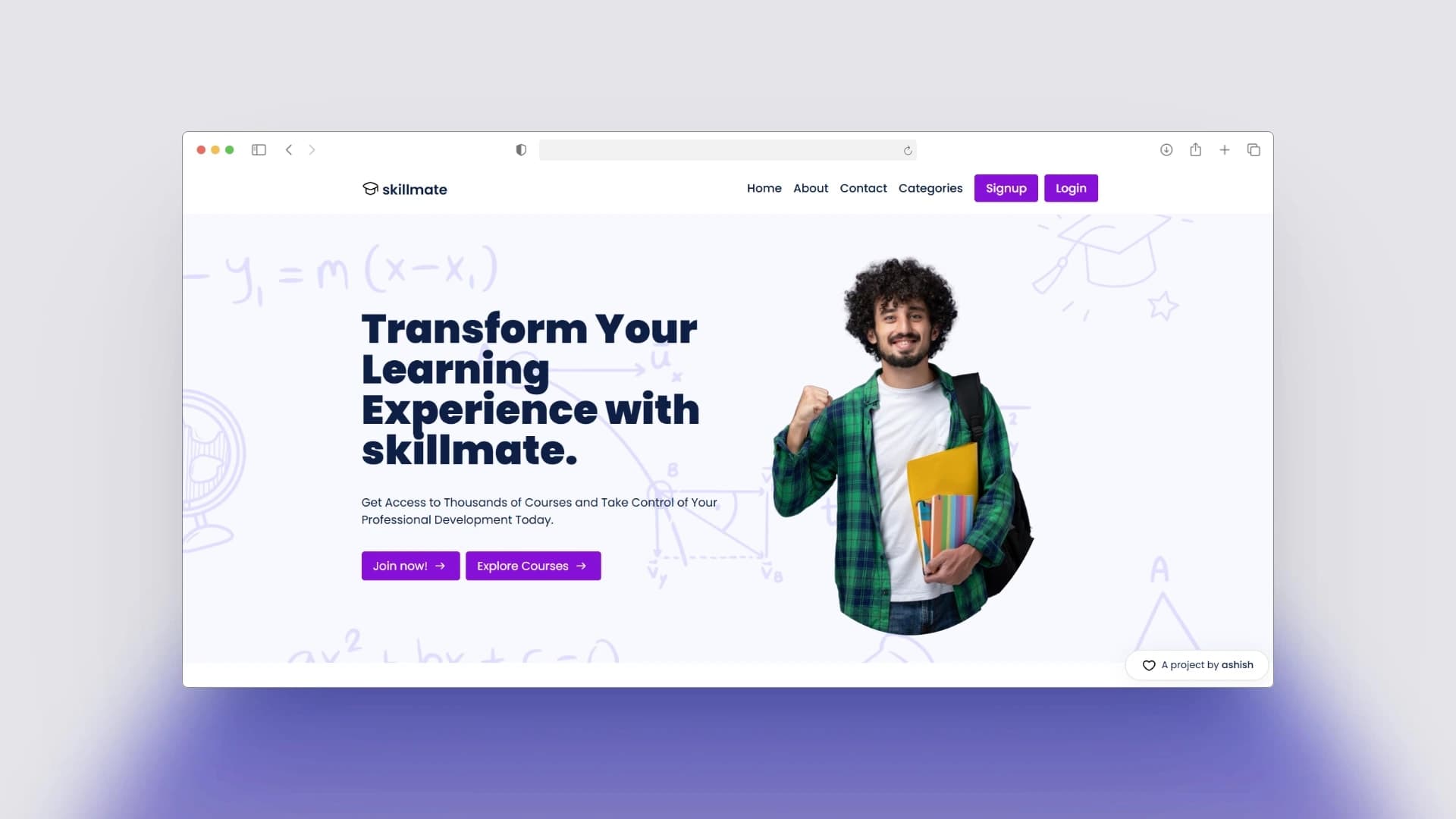
Learning platforms often suffer from "feature bloat"—complex, slow interfaces that hinder rather than help education. For Skillmate, I reimagined the LMS experience, building a lean, high-performing ecosystem where course orchestration meets seamless cloud-based media delivery.
It’s more than a course list; it’s a scalable infrastructure for creators and learners.
The "Real" Challenge
An LMS isn't just a website; it's a content delivery engine. The primary technical challenge was managing 4K video streams and high-resolution thumbnails without taxing the server’s local storage or processing power. I needed a way to handle high-concurrency uploads and provide instant streaming availability while maintaining a robust backend for student enrollments and instructor analytics.
My mission: A zero-latency media experience, a data-driven dashboard, and a professional aesthetic that inspires trust.
My Approach: Orchestration x Scalability
1. Cloud-Native Media Management
To solve the storage and streaming bottleneck, I integrated Cloudinary directly into the Django ORM. By using CloudinaryField for course thumbnails and lesson videos, I offloaded heavy media lifting to a global CDN. This ensures that even during peak traffic, video playback remains buffer-free.
# Leveraging Cloud-Native fields for scalable media
class Course(models.Model):
    thumbnail = CloudinaryField('thumbnail')
    featured_video = CloudinaryField('featured_video')
    lesson_video = CloudinaryField('lesson_video', null=True)

    def save(self, *args, **kwargs):
        # Auto-generating slugs for SEO-friendly course URLs
        self.slug = slugify(self.title)
        super().save(*args, **kwargs)
2. Data-Driven Insights
I built a centralized Dashboard Engine that aggregates real-time data for instructors. Using Django’s powerful querysets, the system calculates student enrollment trends and course performance metrics on-the-fly, providing actionable insights with zero performance overhead.
3. Typography-Led UX
I chose the Poppins typeface to establish a professional yet approachable brand identity. The UI uses a minimalist color palette (Royal Blue & Vibrant Purple) and a card-based architecture to make complex course catalogs feel airy and organized.
/* Clean, typography-focused design system */
body {
    font-family: 'Poppins', sans-serif;
    color: #0e2045; /* Professional deep blue */
}

.btn {
    background-color: #8710d8; /* Action-oriented purple */
    transition: transform 0.2s ease-in-out;
}
The "Goodies" (Key Features)
Adaptive Course Uploads
Instructors can upload entire courses—including requirements, multi-part content, and videos—in a single, streamlined flow. The system handles the background processing of media while the instructor continues their work.
Intelligent Enrollment Logic
A robust relation-based enrollment system that prevents duplication and ensures students have instant access to purchased content. It tracks progress and enrollment dates across time zones (using pytz).
Responsive Learning Matrix
From desktop to mobile, the course viewer remains focused. Integrated HTML5 video players with Cloudinary backends ensure a premium learning experience on any device.
What I Learned
Skillmate taught me that the "vibe" of a professional platform is built on data integrity. It proved that by offloading media to the cloud and focusing on a clean backend architecture, you can build a platform that feels like a premium SaaS product with a fraction of the overhead.
The result? A platform that empowers instructors to teach and students to grow—without the technical friction.